
Unitree Go1 Autonomous Robodog
A real-time edge AI system for language-guided autonomous motion, combining onboard perception, local language processing, and quadruped control.
Project Overview
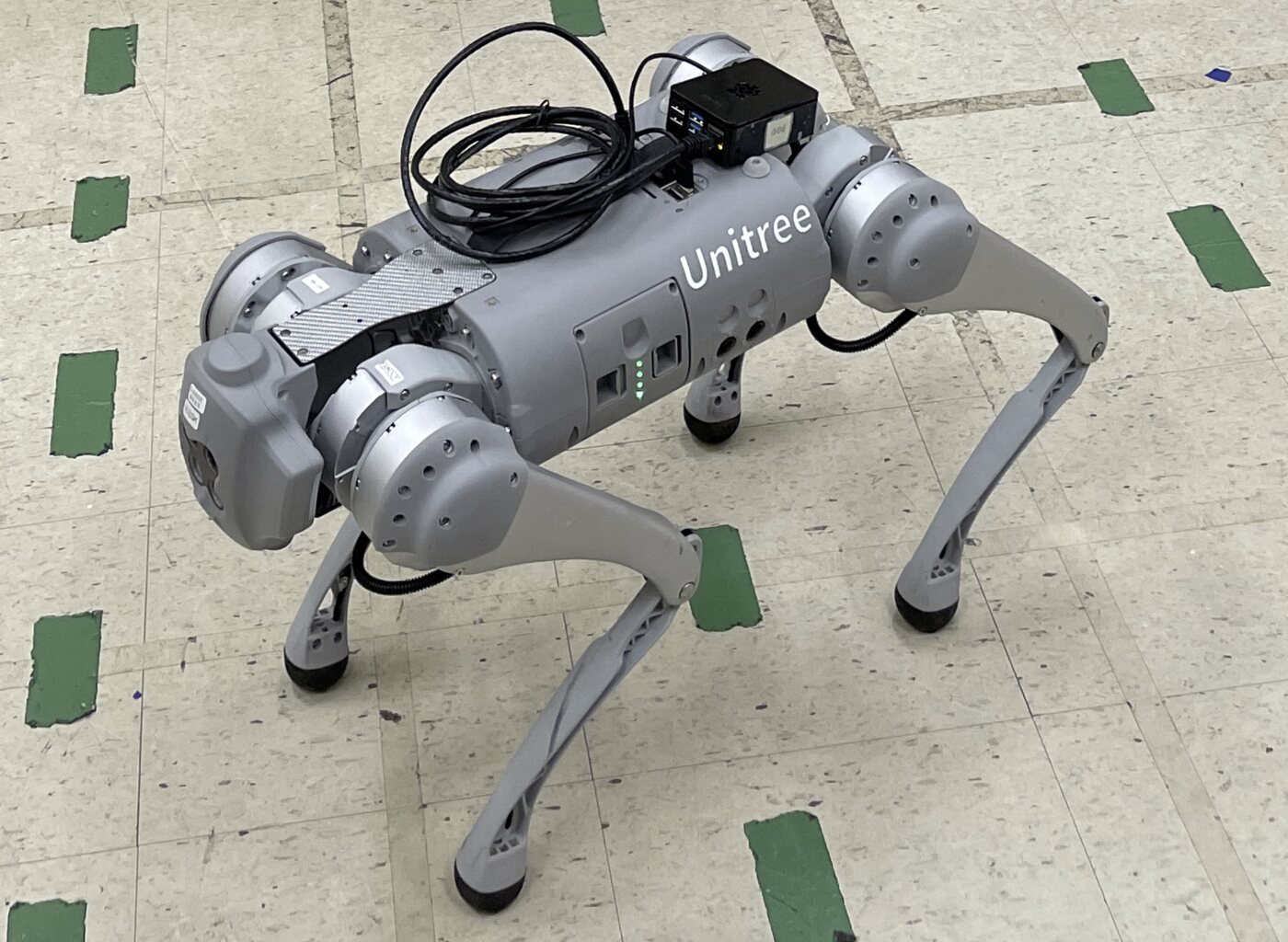
This project investigates how a quadruped robot can translate natural-language instructions into physical motion while continuously interpreting its surroundings. The system keeps the perception and language pipeline at the edge, reducing dependence on remote cloud services and the network delays they introduce.
The experimental platform combines the Unitree Go1 EDU with NVIDIA edge computers, TensorRT-optimized YOLO object detection, a local Ollama Llama 3.2 language model, and a software driver that coordinates perception, planning, and motion.
System Architecture
Experimental Method
Ten YOLO configurations—YOLOv11 and YOLOv26 in nano, small, medium, large, and extra-large sizes—were evaluated under PyTorch FP32 and TensorRT FP32, FP16, and INT8 execution. The experiments measured:
- real-time inference throughput in frames per second (FPS),
- COCO 50–95 mean average precision (mAP), and
- local language-model response time for short and multi-step motion prompts while the vision pipeline was active.
Experimental Results
YOLOv26n, TensorRT INT8
TensorRT INT8
Llama 3.2 with YOLOv26m FP32
| Configuration | Measured FPS | Measured COCO 50–95 mAP | Interpretation |
|---|---|---|---|
| YOLOv26n, TensorRT INT8 | 50.24–63.93 | 36.65% | Highest throughput in the experiment. |
| YOLOv26m, TensorRT FP16 | 32.50–35.74 | 51.89% | Strong accuracy retention with real-time performance. |
| YOLOv26m, TensorRT INT8 | 38.83–42.72 | 46.49% | Faster execution with a larger accuracy tradeoff. |
The FP16 results for all ten tested models remained within approximately 1.5 percentage points of their expected COCO benchmark mAP. For the representative YOLOv26m FP32 test, Llama 3.2 generated a short motion command in 4.113 seconds and a longer multi-step command in 11.853 seconds.
Key takeaway: TensorRT substantially increased vision throughput. The results highlight the practical tradeoff among model size, numerical precision, detection accuracy, and the compute capacity available for concurrent language processing. The project poster identified YOLOv26m as the most useful overall balance for the autonomous platform.
Challenges and Future Work
The Jetson Orin Nano could not efficiently run language models larger than Llama 3.2, while smaller models were not always reliable when generating motion commands. Future work includes improving command validation, reducing language-model latency, and evaluating more capable compact models for safer closed-loop autonomy.
Project Team and Support
This work was conducted by Max Yagel, Nitish Patil, and Dr. Yu Luo. It was supported by NSF Grant 2348711 and the Mississippi State University Intelligent Edge Computing Systems REU. The Unitree Go1 EDU platform was provided by Dr. Lina Pu.